
Beyond an Answer Machine: AI and the Future of Student Inquiry
Catalyzing Curiosity: Where Science Education Meets the AI Frontier. By Lisa Deslaurier — Senior Director of Content, EduSmart
Curiosity drives learning. In science classrooms, learning starts with a question, grows through investigation, and leads to deeper understanding. AI can strengthen that process — but only when it expands thinking rather than replaces it.
At its core, science education is not about answers. It is about questions. Inquiry-based learning invites students to observe, hypothesize, test, and refine their thinking. This process builds not only content knowledge but also critical thinking, persistence, and intellectual independence. Deep learning happens when students do more than find answers — it happens when they ask better ones.
AI as a cognitive partner
Traditional classroom constraints — time, resources, and access to data — can limit how deeply students engage in authentic inquiry. This is where AI begins to shift the landscape.
AI tools can function as dynamic collaborators in the inquiry process. Rather than serving as answer machines, they can:
- Generate testable questions based on student observations
- Simulate complex systems that are otherwise inaccessible in classroom settings — climate models, cellular processes, ecosystem dynamics
- Provide immediate feedback on experimental design or reasoning
- Help students analyze large datasets, revealing patterns that would be difficult to detect manually
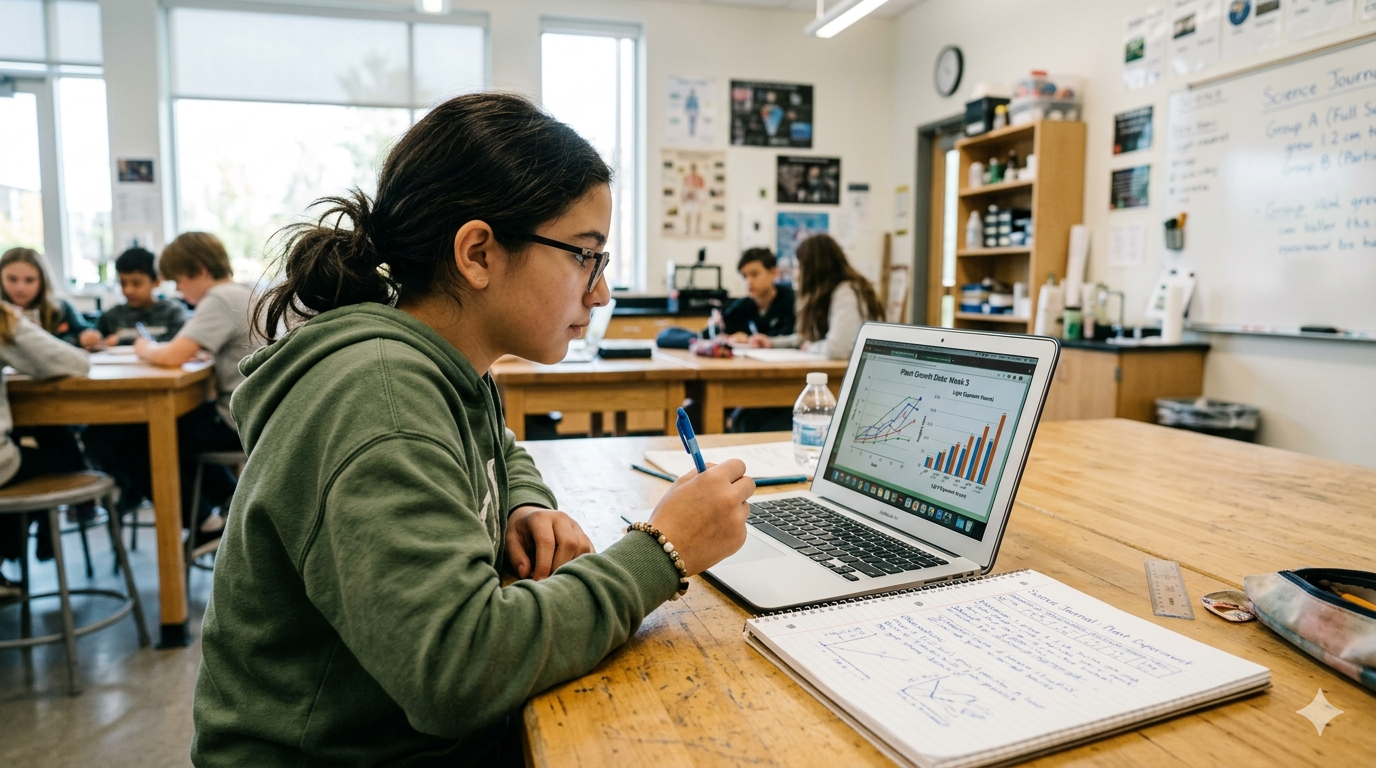
By stepping into this collaborative role, AI allows students to shift their energy from data organization to higher-level analysis. A student studying ecosystems, weather, or energy use can leverage AI to synthesize observations and surface explanations — while still retaining the responsibility to gather evidence and evaluate conclusions. That balance keeps curiosity active and learning authentic.
A practical example
Consider an ecology investigation where students monitor how soil moisture changes across a schoolyard over a month, using inexpensive digital meters. Because data is collected at different times of day by multiple classes and across varied locations, the variables can be messy and difficult to parse. To get a holistic view, classes combine their data into a single shared dataset.
With that combined data, students prompt an AI tool: "What patterns or trends do you see in this soil moisture data?" The AI might highlight that areas near trees retained significantly more moisture, or that afternoon readings dropped consistently compared to morning readings.
Rather than accepting this as the final answer, students compare these interpretations to their own real-world observations. They must evaluate whether the patterns hold true across all data points — and investigate what other variables, such as temperature, slope, groundcover, or recent rainfall, could explain the trend.
AI helps highlight the patterns. The students explain and refine the conclusions. Technology becomes a means to deepen inquiry, not shortcut it.
Why this matters
AI is fundamentally changing how students access information — but it does not diminish the value of human curiosity. If anything, it makes curiosity more vital than ever. The students who thrive in an AI-accelerated world will be the ones who ask strong questions, verify evidence, and keep exploring when the answer is not obvious.
The goal is not to create students who merely know how to use AI. It is to create students who can think with it — while remaining curious, skeptical, and driven to understand the world around them.
Curiosity has always been the spark. AI is simply adding fuel.
Want to see AI-powered inquiry in action?
EduSmart's science platform uses AI to support student thinking at every stage of investigation — with real-time feedback, adaptive scaffolding, and TEKS- and NGSS-aligned content built for K–12 classrooms.
Start Your Free Trial →
Lisa Deslaurier is the Senior Director of Content at EduSmart. In Catalyzing Curiosity: Where Science Education Meets the AI Frontier, she explores how science learning and AI can work together to deepen student thinking and engagement.